


“Let’s test it with a real project before subscribing for everyone”
That is the sentence that tends to come up once your team’s technical leadership has already heard of Kiro, already seen the per-user price table, and still hesitates to subscribe to the highest-capacity plan for 30 or 50 developers at once. The hesitation is reasonable: an AI coding tool changes how the team writes, reviews, and documents its work, and that kind of change is easier to evaluate with data from a real project than with a 15 minute demo in a meeting. The problem is that “testing carefully” tends to mean months of indecision, with no set deadline to reach an answer, while the team keeps working the old way in the meantime.
What the Kiro Power PoC actually is
The Kiro Power PoC (proof of concept), run by CloudDog, exists to solve exactly that impasse: it tests Amazon Kiro Power on a real team at your company, for up to 3 months, with scope closed around 1 squad and 1 real project, not a generic pilot with no time or scope limit. The fixed deadline is part of the design: the company knows, from the start, when it will have an answer about whether extending the subscription to more squads is worth it, instead of letting the trial drag on indefinitely until someone decides to end it.
Why 1 squad and 1 project, not the whole team at once
Testing with the whole team at once sounds faster, but in practice it dilutes the result: it becomes hard to separate what is Kiro Power’s effect from what is normal noise in a quarter full of different priorities, across several teams at the same time. With 1 squad and 1 real project, CloudDog and your company can closely follow what changes in that specific team’s day to day, with regular checkpoints, instead of a statistical average over dozens of people that cannot safely be attributed to a single cause.
Step 1: the initial 20 minute conversation
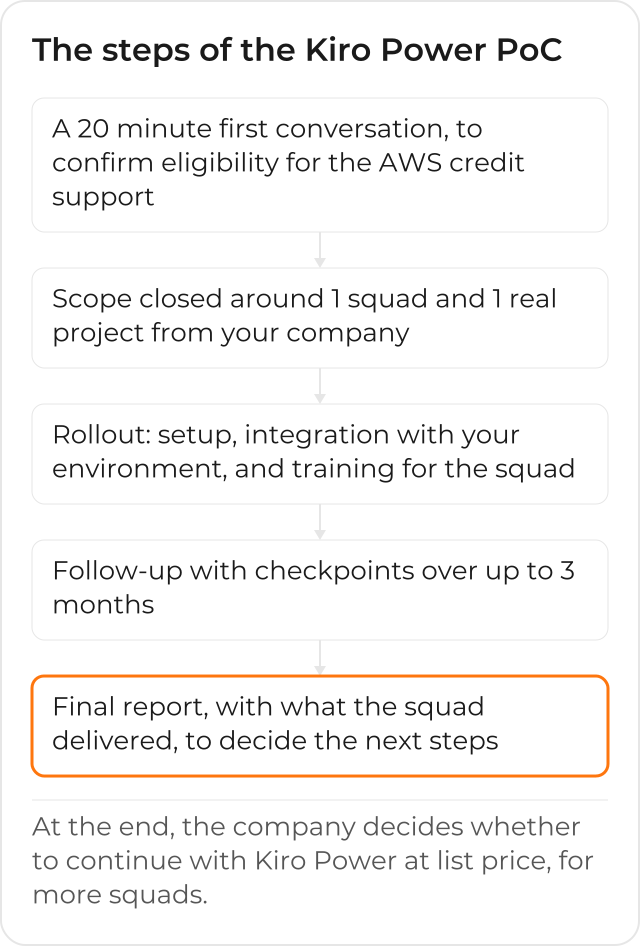
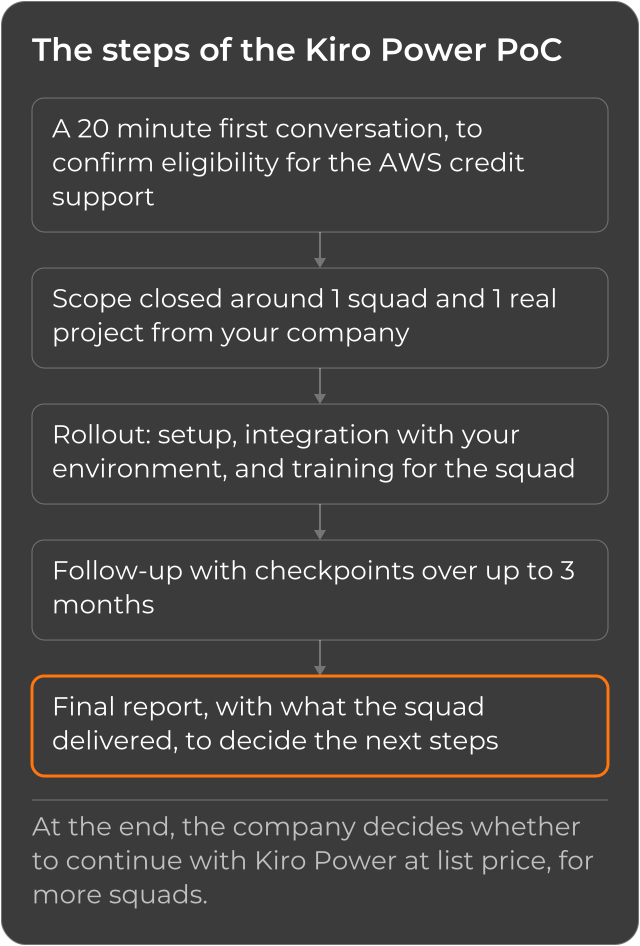
Everything starts with a 20 minute conversation, with no commitment to subscribe to anything afterward. That conversation aligns your company’s eligibility for AWS’s credit support (the “Kiro credit,” which helps cover the Kiro Power licenses during the trial, subject to eligibility validated by AWS itself) and, together with your team’s technical leadership, which squad and which real project will enter the PoC. This is the moment the scope gets closed: there is no switching projects mid-trial and still comparing before and after fairly.
What makes a project a good candidate
A real project already in progress, with deliveries planned for the coming months, tends to be a better candidate than a fictional project created just for the trial: the squad already has context, priorities, and real deadline pressure, which is exactly the scenario where an AI coding tool needs to prove its value. The initial conversation exists to align this choice with whoever will lead the squad during the PoC.
What is not part of this conversation
The initial conversation is not a contract negotiation or a long sales pitch: in 20 minutes, the goal is to confirm eligibility for the credit support, agree on the squad and the project, and clarify what is charged for the PoC (the rollout, the follow-up, and the final report). Decisions about budget beyond the PoC and the number of squads that would be involved in a future expansion are left for after the final report, once there is already a concrete result to base those choices on, instead of deciding everything upfront, in the dark.
Step 2: rollout, on the squad’s own environment
With the squad and the project defined, CloudDog rolls out Kiro Power to that team: setting up the environment in the squad’s AWS account, and training on the practices of specs, steering, and hooks, so the squad starts working with Kiro in the day-to-day of the chosen project, rather than exploring the tool in isolation from any real delivery. Training covers enough for the team to start using the Kiro Power plan’s features, without requiring every developer to learn everything on their own, reading the documentation from scratch.
Step 3: follow-up with checkpoints, through to the final report
Throughout the PoC, for up to 3 months, follow-up continues with regular checkpoints between CloudDog and the squad’s leadership: it is not a trial the company receives at the start and only reviews at the end, with no visibility into how it is going along the way. Each checkpoint is a chance to adjust whatever is not working well (a workflow the squad has not yet adopted, an integration still missing) before the 3 month deadline runs out without those corrections.
The final report, and the decision it exists to support
At the end of the PoC, a final report sums up what the squad managed to deliver with Kiro Power on the chosen project: it is not a list of features used, it is that team’s concrete result on that project, which is exactly the data point missing from the technical leadership’s conversation at the start of this post. With that report in hand, the company decides whether to continue with Kiro Power at list price, extending the subscription to more squads, or to end the trial with no additional cost beyond what was already incurred during the PoC.
What goes into the report, with no standardized market figure
The final report does not compare your squad to some generic “percent faster” average that applies to any company: it describes what that specific squad delivered on that specific project, with Kiro Power, within the PoC’s deadline. That is a deliberate choice: a market average figure, applied to your context with no adjustment, tends to promise more than your reality later confirms. The report serves your company’s decision, not to be cited as a general statistic.
How your team’s decision looks after the PoC
Whoever goes through the PoC trades the question “is it worth subscribing for everyone” for a decision based on what 1 real squad delivered, on 1 real project, within a deadline known from the start. If the result is good, extending to more squads starts from concrete data from your own environment, not from a market average or another company’s case study; if it is not, the company ends the trial knowing exactly what did not work, instead of being left with the doubt of “maybe it should have been given more time.”
CloudDog, an AWS Advanced Partner, runs the Kiro Power PoC from the first contact to the final report, with AWS credit support to help cover the licenses during the trial. See the plan table and the credit support details on the Kiro Power page.
