


Choosing the Wrong Consultancy Costs More Than the Contract
When your team decides to hire a cloud consultancy, the initial question is usually just the price. But the real cost of choosing the wrong consultancy isn’t the monthly fee: it’s the project that gets delayed, the architecture that needs to be redone a year later, or the internal team left not knowing what was actually delivered. The 7 questions below help tell a consultancy that’s actually prepared from one that only looks prepared in the proposal. The problem rarely shows up in the first meeting, because every consultancy knows how to give a convincing pitch; it shows up months later, once the project has already started and the initial evaluation’s gaps become visible day to day.
The 7 Questions, Grouped into 3 Stages
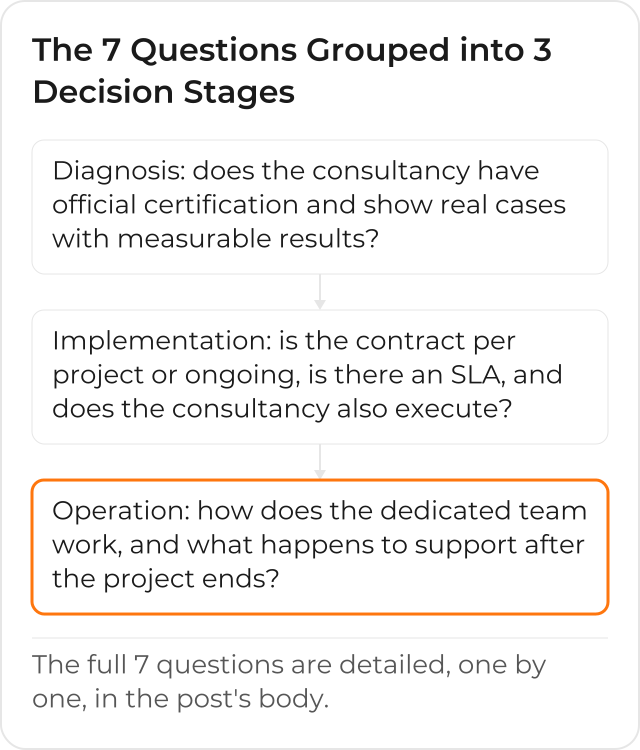
The 7 questions group into 3 decision stages: what the consultancy has already proven it can do, how it will execute the project, and what happens after it ends.
1. Does the Consultancy Have the Cloud Provider’s Official Certification?
A certified partnership, such as the AWS Advanced Tier, is publicly verifiable through the AWS Partner Solutions Finder and requires a minimum number of certified professionals and launched opportunities, evaluated by the cloud provider itself, not just a claim on the consultancy’s own website.
2. Does It Show Real Cases, with Measurable Results?
Ask for concrete examples: what changed, by how much, in how long. A consultancy that only speaks in generic terms, like “we improved performance,” without saying from what to what, hasn’t made clear what it actually delivered in previous projects. Asking for a previous client’s contact, beyond the published case, is also a fair question: a consultancy confident in its own work usually doesn’t hesitate to offer that reference.
3. Is the Contract per Fixed Project or Ongoing Consulting?
Both options make sense, but for different reasons: a fixed project solves a one-time migration or modernization, with a defined start, middle and end; ongoing consulting follows the operation over time, reviewing the architecture as usage grows. Knowing which one your company needs avoids hiring the wrong model and finding that out only halfway through.
4. Is There a Response SLA, and for What Exactly?
Ask what the SLA actually covers: response time to an incident, delivery time for a project stage, or both at once. The phrase “we have an SLA,” without that detail, says nothing about what’s actually guaranteed in the contract.
5. Does the Consultancy Only Diagnose, or Does It Also Execute?
Some consultancies deliver a recommendations report and leave; others follow the implementation through to the end, including the fine-tuning after the environment is already in production. That changes quite a bit what your company gets for the same initial investment.
6. How Does the Team Serving Your Company Work?
Ask whether it’s a dedicated team or one shared across several clients at once, and whether whoever presents the sales proposal is who will actually execute the project after the contract is signed. The answer reveals whether the consultancy has real capacity for the volume of clients it already serves.
7. What Happens After the Project Ends?
Ask about post-delivery support: whether it ends on the contract’s last day, or whether there’s a continuity path, such as management or monitoring, for whoever wants to keep the follow-up after the formal delivery.
Warning Signs When Evaluating a Proposal
Beyond the 7 questions, some signs in the proposal itself already indicate risk before any meeting. A budget far below the other proposals, with no explanation of where the difference comes from, usually means fewer planning hours than the project needs, not efficiency. A proposal that promises a fixed deadline for a project whose scope hasn’t been assessed in detail yet is another sign: without the full initial diagnosis, the deadline is a guess, not an estimate. And a consultancy that avoids putting the SLA and each side’s responsibilities in writing, leaving everything “to be agreed,” is leaving exactly the part that matters most for after the signature. None of these signs alone rules out a consultancy, but more than one showing up in the same proposal is reason enough to ask the 7 questions above directly, out loud, before moving forward.
What These 7 Answers Reveal Together
None of the 7 questions, on its own, decides the choice. A consultancy might have certification without published cases yet, or might have a detailed SLA and a shared team. The value of asking all 7 questions before signing is comparing the answers against each other: a consultancy that answers well on diagnosis and implementation questions, but avoids answering about what happens after the project, is signaling something about how it treats long-term operation. It’s also worth comparing more than one consultancy’s answers side by side, on the same 7 questions, instead of evaluating each proposal in isolation: the contrast between the answers usually shows more than any single proposal on its own.
How to Verify an AWS Partner Certification
The AWS Partner Services Tiers page shows the 3 tiers (Select, Advanced and Premier Tier), with the number of certifications and launched opportunities each one requires, and the listing on the AWS Partner Solutions Finder, which is what makes the tier publicly verifiable. The AWS Well-Architected Framework describes the AWS Well-Architected Partner program, made up of partners with deep AWS knowledge who help companies review and improve workloads. AWS itself also offers the Well-Architected review at no charge, through the AWS Well-Architected Tool; a consultancy that knows this process well usually uses this same vocabulary in its proposal, instead of a proprietary method unrelated to what AWS recommends.
What the ATTO Sementes Case Shows
The case “Cost Optimization and Governance in the AWS Cloud with ATTO Sementes” is the kind of answer question 2 asks for: a measurable result, not a generic phrase about “optimization”: the migration cut cloud costs by 40%, with no loss of performance. The same case also shows what question 7 asks for: ATTO Sementes still relies today on CloudDog’s Managed Services, with periodic follow-up meetings, instead of support ending on the migration contract’s last day.
Get to Know CloudDog’s Cloud Consulting
See how CloudDog, a certified AWS partner, structures strategy and execution in Cloud Consulting, with a dedicated team that follows the project from the initial diagnosis through after delivery.
