


The question that comes before any decision
Before deciding how much your team is going to use Kiro, someone in finance or IT management will probably ask: how much does this actually cost? It is a simple question, but the answer has 2 parts that tend to get mixed up: the public per-user price table, which is on the Kiro website, and the “Kiro credit,” a term that circulates in conversations about the product and that is not a discount or a subscription, but rather AWS’s credit support for a PoC run by CloudDog. Keeping these 2 things apart avoids a common misunderstanding: reading about the credit, assuming it is a cheaper way to subscribe to Kiro Power every month, and getting surprised later by the full bill.
The 5 Kiro plans, side by side
| Plan | Price per user/month | Credits |
|---|---|---|
| Free | $0 | 50 |
| Pro | $20 | 1,000 |
| Pro+ | $40 | 2,000 |
| Pro Max | $100 | 5,000 |
| Kiro Power | $200 | 10,000 |
Values from the official table at kiro.dev/pricing, the same ones already published on the Kiro Power page. Free is perpetual, with no trial deadline: anyone can start on it and stay there indefinitely, with 50 credits per month, renewed every cycle. The difference between the 4 paid plans is, above all, the volume of monthly credits: whoever uses Kiro intensively day to day needs more credits to avoid depending on buying add-on credit often.
The free trial on the first upgrade
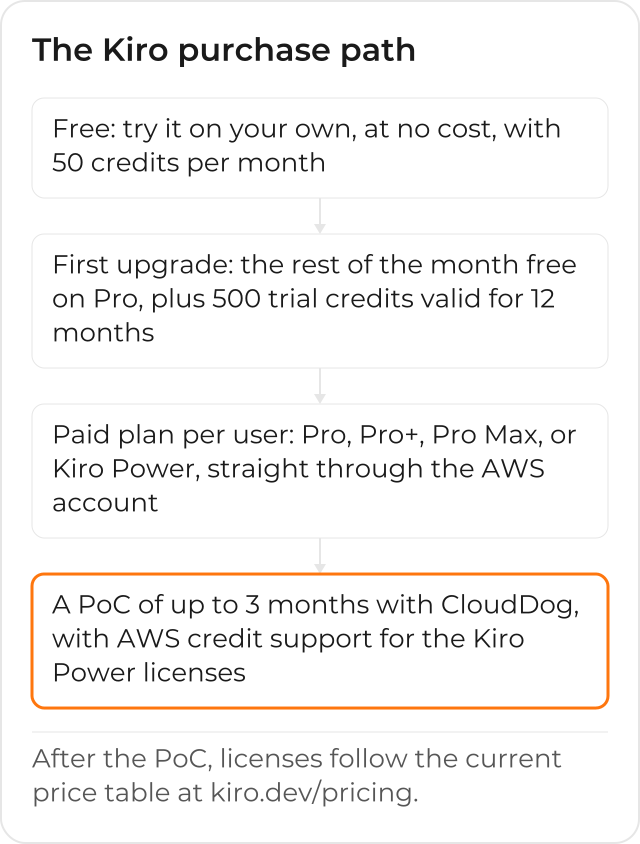
Since November 1, 2026, the first upgrade from Free comes with a free trial: the rest of that month on the Pro plan is free, and the account also receives 500 trial credits, valid for 12 months, usable on any paid plan (Pro, Pro+, Pro Max, or Kiro Power). According to the official billing documentation, if the first upgrade goes straight to a plan bigger than Pro, the account pays only the difference between that plan’s prorated price and the Pro plan’s prorated price, and still receives the 500 trial credits. The benefit applies only once, on the first upgrade; a second plan change after that is billed normally, with no free month.
What “Kiro credit” actually is
“Kiro credit,” as the term is used in conversations about the product, is the AWS credit support that CloudDog uses in the up-to-3-month PoC of Kiro Power. It is not a discount program from the Kiro product itself, nor a credit that replaces the values in the table above: it is an AWS benefit, applied during the trial period run by CloudDog, subject to eligibility validated by AWS itself.
What the credit covers, and what it does not cover
AWS’s credit support helps cover the Kiro Power licenses during the PoC. Implementation,
follow-up with checkpoints, and the final report are part of the PoC run by CloudDog, and what is
charged for that work comes up already in the initial 20 minute conversation: the credit does not
pay for CloudDog’s services, it only helps reduce the cost of the Kiro licenses during the trial.
Eligibility is validated by AWS, and coverage is neither total nor guaranteed for every company
that applies. After the PoC ends, Kiro Power licenses follow the kiro.dev/pricing table normally:
the credit support is for the trial period, not a permanently reduced rate.
Buying for 1 person, or for the whole team
The table above is per user, meant for whoever subscribes plan by plan. If your company is going to subscribe several people with very uneven usage between them, it is worth knowing about credit pooling too: instead of a fixed limit per seat, everyone’s credits go into a shared pot, which anyone on the team draws from as needed. See how it works in Kiro Credit Pooling, if your purchase is for a team, not a single user.
How to know if your company qualifies for the credit support
An initial 20 minute conversation confirms eligibility for the AWS credit support, and aligns the squad and project that will enter the PoC. See the full details and the interactive table by number of developers on the Kiro Power page.
Fractional credits and mid-month proration
The plan table shows a fixed number of credits per month, but consumption, in practice, is not all or nothing. According to the official enterprise billing documentation, credits are consumed fractionally, based on each request: a simple edit or a short prompt uses less credit than a long, complex task. This means the monthly plan limit stretches further than it would if every interaction cost a full credit.
What happens if you upgrade mid-month
On an individual subscription, billing and credits are also prorated to the second, not by a closed day. The billing documentation gives the formula and an example: the share of the month remaining is the seconds left in the billing cycle divided by the total seconds in the month, multiplied by the plan’s monthly fee (for the amount charged) or by the plan’s monthly credits (for the credits received). In a 30 day month (2,592,000 seconds), someone who subscribes to Pro at 00:00 UTC on day 15 has 16 days left (1,382,400 seconds): the prorated fee is (1,382,400 / 2,592,000) × $20 = $10.67, and the prorated credits are (1,382,400 / 2,592,000) × 1,000 = 533 credits. If this same upgrade is the first one from Free, the amount charged in this example drops to $0 (the free trial month), and the account still receives the 533 prorated plan credits, plus the 500 trial credits.
| Plan | Prorated fee | Amount paid (1st upgrade) | Plan credits | Trial credits | Total credits |
|---|---|---|---|---|---|
| Pro | $10.67 | $0 | 533 | 500 | 1,033 |
| Pro+ | $21.33 | $10.67 | 1,067 | 500 | 1,567 |
| Pro Max | $53.33 | $42.67 | 2,667 | 500 | 3,167 |
| Kiro Power | $106.67 | $96.00 | 5,333 | 500 | 5,833 |
(Example from the official billing documentation, for an upgrade at 00:00 UTC on day 15 of a 30 day month. An upgrade later that same day yields a proportionally smaller fee and credit amount, because fewer seconds remain in the month.)
That math applies to someone subscribing to a plan individually. For a company on a per-plan subscription, the rule is different: according to the Enterprise billing documentation, the first month is billed proportionally, but the person gets the plan’s full credit limit from day one, with no proration on credits. Credit pooling works differently: the seat price and the 500 credits it adds to the pool are both prorated in the first month, for anyone joining mid-cycle.
What changes in practice, for whoever is deciding right now
If finance’s question is “how much does it cost to subscribe Kiro for the team,” the answer is in the table: $20 to $200 per user per month, depending on the credit volume the team needs, with the rest of the month on Pro free on the first upgrade from Free. If the question is “how much does it cost to try the highest-capacity plan before subscribing for several squads,” the answer is the PoC run by CloudDog, with AWS credit support covering part of the licenses during the trial, with no service cost built into the credit. The 2 answers coexist: nothing stops the team from already having people using Free or Pro on their own while the company evaluates the Kiro Power PoC for a specific project.
