


Your Team Already Has the Data, but Hasn’t Decided Where to Keep It
Every company that starts organizing its own data runs into a similar question: raw data, as it comes from everywhere, or data already arranged, ready for the question the business team asks every month? The answer isn’t “one is better than the other”: it’s understanding which question your company needs to answer first, and then choosing the right piece for that moment.
It’s common for a technical team to pick the architecture before knowing which question it will answer, because Data Lake and Data Warehouse are terms that come up constantly in any conversation about data. The problem with choosing that way is building an expensive, elaborate structure for a simple question, or the opposite: trying to answer a complex analytical question with a structure meant only for storing files.
What Each One Is, in One Sentence
A Data Lake stores data as it arrives: raw, in any format, from any source, without requiring the structure (the schema) to be defined before storing anything. A Data Warehouse stores data already modeled, structured for a specific type of query, usually analytics or BI, with the schema defined before loading.
Data Lake and Data Warehouse, Side by Side
| Characteristic | Data Lake | Data Warehouse |
|---|---|---|
| Data accepted | Structured, semi-structured, and unstructured | Relational data from transactional systems |
| Schema | Applied at query time (schema-on-read) | Defined before loading (schema-on-write), or at query time |
| Preprocessing | Optional; you can store and decide later | Usually done beforehand, through an ETL process |
| Performance | Prioritizes storage volume and cost | Optimized for the fastest possible query |
| Who uses it | Data scientist, data engineer, analyst | Business analyst, data scientist |
AWS’s official comparison sums up this trade-off well: the Data Warehouse delivers the query result faster, because the data already arrived organized; the Data Lake delivers a much larger storage volume at a lower cost, because it doesn’t require organizing everything before storing it.
Where the Data’s Schema Gets Defined
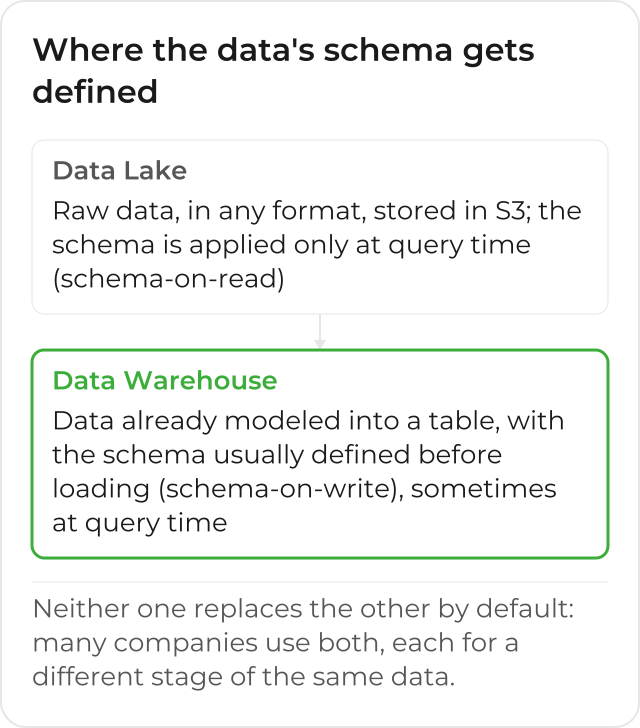
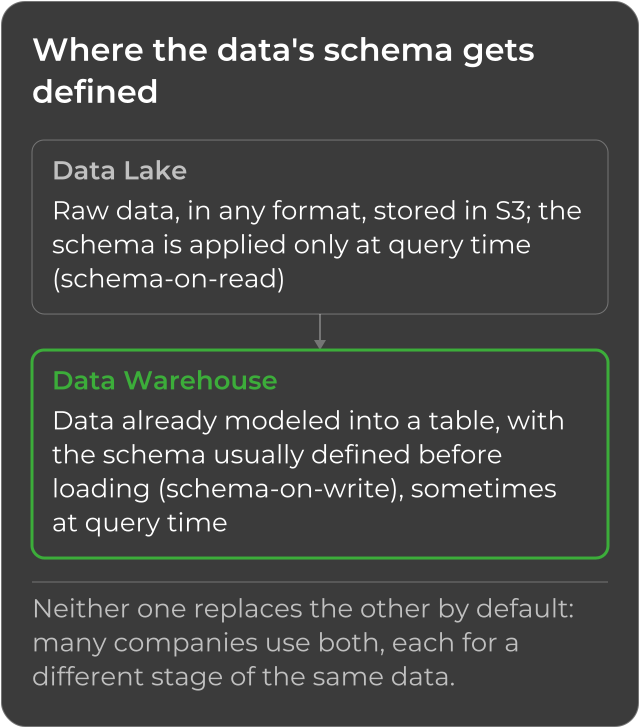
The central difference, according to AWS itself, is when the schema (the structure of columns and data types) gets defined. In a Data Lake, that happens only at query time, the so-called schema-on-read: the data goes in as it is, and the structure is decided later, by whoever queries it. In a Data Warehouse, the schema is usually defined before loading, although it can also be written at analysis time in some cases.
When a Data Lake Works Better
When the company has very different data sources from each other (application logs, spreadsheets, CRM data, files) and doesn’t yet know exactly how it will query all of it in the future. The Data Lake stores the raw data first, to decide the modeling later, without discarding anything for not fitting a fixed format right from the start. It’s also the natural path when the data volume is large and storage cost weighs on the decision, or when the data team is still exploring what exists, before any formal analysis project.
A common example: a company that receives product usage events, CRM data, and financial control spreadsheets, each in a different format. Storing everything raw in the Data Lake first lets the team explore that data together later, without having decided upfront which question each source would need to answer on the day it arrived.
When a Data Warehouse Works Better
When the question the business team needs to answer is already known and repeated (a sales dashboard by region, for example) and the source data is already relatively structured. The Data Warehouse delivers fast queries over a model already built for that question, because the work of organizing the data was already done beforehand, not on every new query.
That’s the case for a finance team that closes the month’s result every week, always with the same questions (revenue by region, by product, by channel): modeling the data once, according to those known questions, pays off the effort of preparing the schema before loading, because the same structure gets queried repeatedly, without needing to be rebuilt every time.
You Can Have Both
Many companies use a Data Lake as the layer that receives raw data from everything, and build a Data Warehouse (or equivalent views) from it for day-to-day analytics queries: one doesn’t necessarily replace the other, each solves a different stage of the same data problem. On AWS, that usually means raw data stored in Amazon S3, organized and with access controlled by AWS Lake Formation, and a slice of that data loaded into a Data Warehouse like Amazon Redshift for queries that need a fast response. Lake Formation centralizes access control over the Data Lake in S3 and the metadata catalog, with fine-grained permissions by column, row, or cell, enforced across analytics services like Amazon Athena and Redshift Spectrum itself, without needing to repeat that setup in each tool separately.
Where to Start
If your company has data spread across different systems and still isn’t clear on how it will use them, the starting point is usually the source assessment, not the architecture choice: only after knowing what exists, where it lives, and who queries it does the decision between Data Lake, Data Warehouse, or both become easier to make with confidence.
How Your Team’s Decision Looks
After that assessment, the question stops being “which technology is better” and becomes “which business question does this structure need to answer, and how often”. A team that can answer that chooses between Data Lake, Data Warehouse, or both with the same clarity it uses to choose any other tool: by the problem it solves, not by the trend of the moment. And if the answer changes a year from now, the right architecture is the one that lets you add the other piece later, without having to start from scratch.
See how CloudDog’s Data Consulting and Data Lake with AWS works, from the source assessment to the right architecture for what your company needs to query.
