
Features
Enables efficient and secure Data Lake management, with granular access control, activity monitoring, and regulatory compliance, ensuring a trustworthy environment for data storage and analysis.
The scalable and secure storage of Amazon S3 is organized into Bronze, Silver, and Gold layers, allowing ingestion of raw data, intermediate transformations, and optimizations for strategic analyses. This structure promotes operational efficiency and accessibility for various teams.
Provides advanced transformations and automation of ETL processes, ensuring that data is prepared for real-time analysis and strategic reporting. The solution includes partitioning and compression to maximize performance.
Offers fast and reliable queries directly in the Data Lake, enabling ad hoc analyses and critical decision support, all without needing to provision additional infrastructure.
Automates data processing workflows, ensuring that the different stages of the pipeline are executed reliably, scalably, and monitored.
Ensures secure and efficient data transfer from on-premises or other cloud databases to the AWS Data Lake, using a VPN Site-to-Site for enhanced security and reliability.
Centralizes and organizes the Data Lake metadata, facilitating the discovery, classification, and usage of data by different tools and teams, promoting reuse and efficient management.
Simplifies the management and protection of credentials and secrets required for integration with external systems and data sources, ensuring compliance and connection security.
Amazon EMR enables you to run big data frameworks such as Apache Spark, Hadoop, and Presto directly on data stored in the Data Lake. It is ideal for complex analytics, machine learning, and distributed workloads, and automatically scales to efficiently manage large clusters.
The Data Lake, organized into tiers (Bronze, Silver, and Gold), provides a robust foundation for training machine learning models on Amazon SageMaker. Native integration with services such as AWS Glue DataBrew makes it easy to prepare data for predictive and prescriptive analytics, while Amazon Forecast and Amazon Comprehend can be used to create predictive insights and advanced text analytics.
Architecture
For this solution, we provide case-specific architectures, offering alternatives to typical Data Lake implementations with varying levels of scalability, cost efficiency, and process automation. Each architecture is designed to address specific use cases, including data ingestion via APIs, integration with external databases, highly complex scenarios with advanced governance, and real-time data streaming.
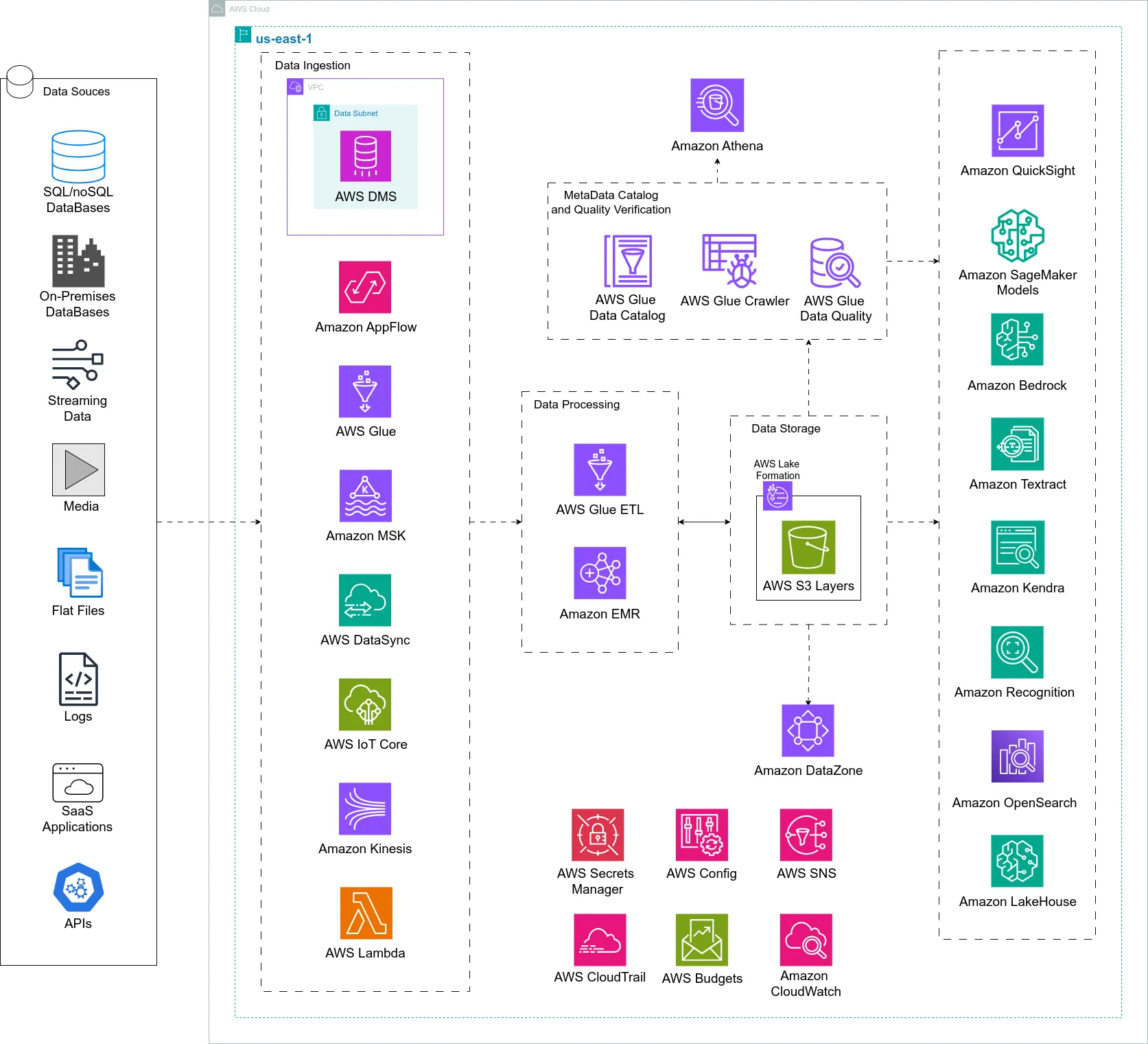
Use Case
Data Lakes for High-Volume Processing
Perfect for companies managing large data volumes, such as banks, insurers, or industries with multiple data sources.
Analytics for Strategic Decision-Making
Ideal for organizations that need optimized and ready-to-use data for fast analysis, such as BI companies or marketing departments using machine learning to predict trends.
Storage and Processing of Complex Data
Great for scenarios requiring the processing of heterogeneous and unstructured data, such as system logs, media files, or large datasets used in scientific research.
Storage and Processing of Real-Time Data
Excellent for scenarios that require real-time data capture, processing, and storage, such as clickstream, video stream, log stream, and others.
Data Compliance and Security
Essential for organizations that must comply with strict regulations like GDPR, LGPD, or HIPAA, ensuring the protection of sensitive data and the implementation of robust access controls. Ideal for sectors like healthcare, finance, and government, where data governance and auditing are crucial.
Machine Learning and Artificial Intelligence
Essential for companies that want to explore predictive and prescriptive analytics, using data organized in the Data Lake to train machine learning models. The Data Lake serves as the basis for AI solutions in areas such as content personalization, demand forecasting, and sentiment analysis. With integration with services such as Amazon SageMaker, it is possible to develop and deploy models directly on the stored data.
Who It's For
For companies with data across multiple systems (CRM, ERP, spreadsheets, application logs) that need a single, reliable source for analysis, from those who never structured a data lake to those who already have one and want to reduce storage and query cost.
How the Consulting Works
Diagnosis
of current data sources
Architecture design
S3, Glue, Athena and Lake Formation
Implementation
with governance
Training
for your team
The first Data Lake dashboard is ready within the first 2 weeks. The timeframe for the full project is still set during the diagnosis.