


“Kiro Power” is not a synonym for “the company plan”
It is easy to hear “Kiro Power” in a conversation about adopting AI in code and assume it is the only plan a company can subscribe to, since it is the most complete one in the table. That is not quite right: your team can subscribe to any of Kiro’s paid plans through the company’s AWS account, with login through whatever identity provider you already use, and Kiro Power is just the plan with the most credits per user, not “the corporate plan.” The right question is not “Free or Kiro Power,” it is how many credits your team actually needs per month, and whether the best way to buy is a fixed plan or a shared pot.
The 5 plans, side by side
| Plan | Price per user/month | Credits |
|---|---|---|
| Free | $0 | 50 |
| Pro | $20 | 1,000 |
| Pro+ | $40 | 2,000 |
| Pro Max | $100 | 5,000 |
| Kiro Power | $200 | 10,000 |
(Values from the official table at kiro.dev/pricing.) The difference between the paid plans is mostly the volume of monthly credits: whoever uses AI in code more intensively day to day needs a plan with more credits, to avoid depending on buying add-on credit often. Credits, on top of that, are consumed fractionally per request, according to the billing documentation: a small edit costs less credit than a long task, so the monthly limit stretches further than the table alone suggests.
Any paid plan can be the company’s, not just Free
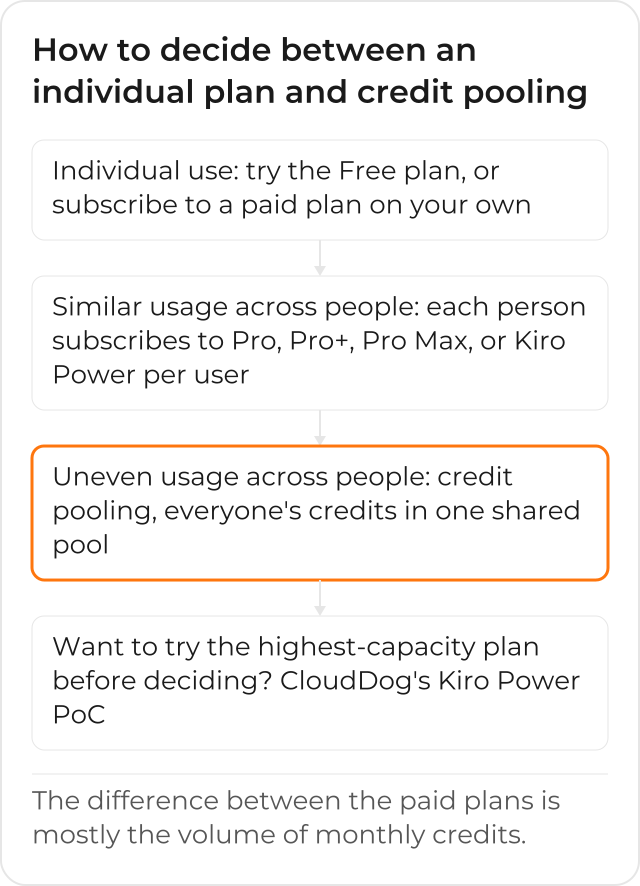
A developer can try Kiro on their own on the Free plan, which is perpetual. On the first upgrade from Free, since November 1, 2026, the rest of the month on Pro is free, and the account still gets 500 trial credits valid for 12 months, usable on any paid plan. For the company, the path is essentially the same: it can also subscribe to any paid plan (“Pro,” “Pro+,” “Pro Max,” or “Kiro Power”) per user, straight through the AWS account, with login through AWS IAM Identity Center or whatever identity provider it already uses (Okta, Microsoft Entra). Kiro Power is not mandatory for a corporate subscription: it is only the highest-capacity plan per person.
When the credit volume matters more than the plan’s name
A small team, with similar usage across people, usually fits well into a single plan for everyone: if the typical work is code review and small adjustments, Pro or Pro+ tend to be enough; if it includes large refactors often, Pro Max or Kiro Power avoid repeated add-on credit purchases. The tipping point is not company size, it is usage pattern: 2 teams of the same size can need different plans, depending on how much each one uses Kiro per day.
Credit pooling: the other way to buy, for teams with many users and uneven usage
Instead of subscribing each person to a fixed plan, the company can also use credit pooling: credits from several seats added into a shared pool, which the whole team draws from according to each person’s need, instead of each seat having an isolated limit that expires unused. This model is now the default for new Kiro Enterprise customers, and an existing Enterprise customer can opt in whenever they want. See how it works, the price per seat, and the governance limits in Kiro Credit Pooling.
When it is worth trying Kiro Power with CloudDog, before deciding
Not every company knows, up front, how much credit the team will need once everyone is using Kiro day to day. CloudDog runs a Kiro Power PoC, the plan with the most credits per user, with AWS credit support (the “Kiro credit”), for the company to try the highest-capacity plan with a real project, before deciding on the subscription for more squads. See the price of each plan and what the credit covers in How Much Is Kiro Power, and how the PoC works in Kiro Power PoC in Up to 3 Months.
Even without credit pooling, the individual plan has add-on credit
Whoever does not need (yet) a shared pot does not get stuck once the monthly limit runs out. According to the enterprise billing documentation, all 4 paid plans (Pro, Pro+, Pro Max, and Kiro Power) allow buying add-on credits on an opt-in basis, when a specific month’s usage goes over the plan’s limit. That is an important difference when comparing with credit pooling: buying add-on credit, on an individual plan, solves 1 person’s one-time spike; pooling solves the imbalance between people on the same team, month after month, without an emergency purchase for whoever is always at the limit while another team member has leftover credit.
3 questions to decide between a fixed plan and credit pooling
- Does usage vary a lot from person to person on your team? If so, pooling tends to make better use of the credit purchased; if usage is similar across everyone, a fixed plan per person already works.
- How many people will use Kiro? Credit pooling requires a minimum of 2 seats; for a single person, an individual subscription is the only path.
- Does the company already use AWS IAM Identity Center? The pool’s groups can come straight from it, which makes administration easier; without it, groups can still be created manually, only requiring more work from whoever administers the account.
None of these 3 answers, on its own, forces the company to decide today: it is possible to start with individual plans, measure the usage pattern for a few months, and migrate to credit pooling later, when the company is ready for it. The decision also does not need to wait for the whole team to be on Kiro: a pilot with 1 squad already shows whether usage varies a lot between people, before extending the subscription to the rest of the company.
Summing up the choice for your team
For an individual trial, Free is enough, at no cost and with no deadline. For the company, the question is not “Kiro Power or nothing”: it is how many credits your team needs per month, and whether it is better to subscribe each person to a fixed plan or share credits through the pool, when usage varies a lot from person to person. CloudDog’s Kiro Power PoC, run with AWS credit support, exists precisely so this decision gets made with data from a real project, instead of a guess in the dark.
See the interactive table by number of developers and the credit support details on the Kiro Power page, or get to know Amazon Kiro by CloudDog for the rest of the adoption process.
